Background
Project category tags
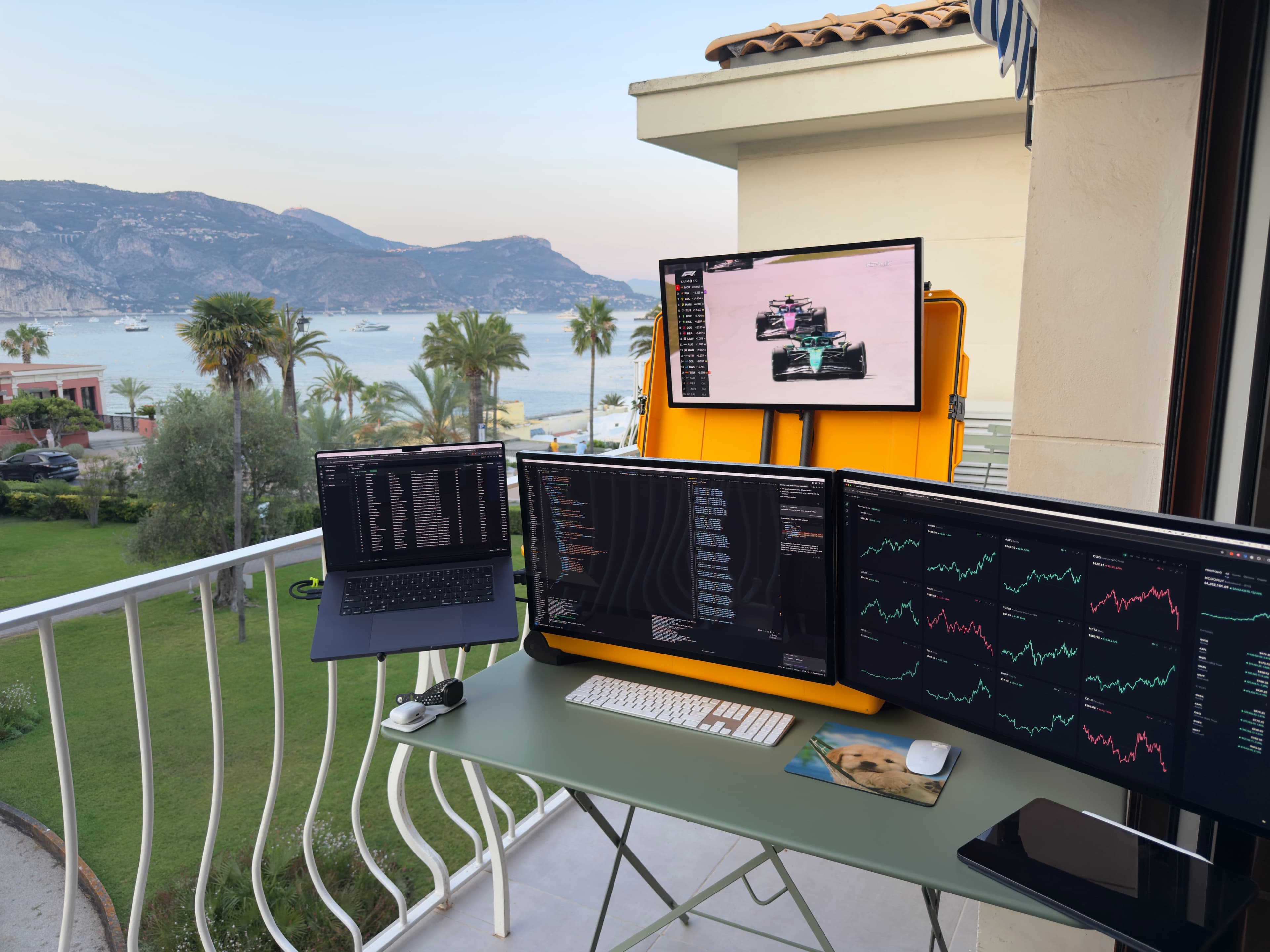
The idea started in 2021 when I was trading from hotel rooms during COVID. Laptop screens are fine for browsing, but for serious multi-chart setups you need real estate. Portable monitors existed but were always a mess of cables, stands, and adapters. I wanted something purpose-built.
Goals
The core design requirements were driven by one question: what would make a trader actually bring this on a trip?
- Truly portable — must fit in overhead bin or under seat
- Single-cable setup — plug in one USB-C and everything works
- No external power bricks — bus-powered from laptop
- Modular design — screens replaceable independently
- Standard VESA mounting for each panel
- Quick-release connectors for video + power
- Future-proof for higher-res panels
- Under $500 BOM — accessible, not a luxury toy
Technical Architecture
The system uses a DisplayLink DL-6950 chipset for USB-C to quad HDMI conversion. Each panel runs through an independent RTD2660Hcontroller board for input handling.
Power Budget
Total power draw is ~45W across all four panels. The USB-C PD spec allows up to 100W, so we have plenty of headroom:
- 4× panels @ 8W each = 32W
- DisplayLink hub = 5W
- Controller boards = 4W
- Cable losses = ~4W
// Power monitoring sketch (Arduino)
void loop() {
  float voltage = analogRead(V_SENSE) * (5.0 / 1023.0) * 11.0;
  float current = (analogRead(I_SENSE) - 512) * (5.0 / 1023.0) / 0.185;
  float power = voltage * current;

  Serial.printf("%.1fV  %.2fA  %.1fW\n", voltage, current, power);
  delay(1000);
}
Chassis Design
The case is 3D-printed in ASA (not PLA — needs heat resistance for car trunks). Key design decisions:
- Living hinges between panels for single-piece folding
- TPU flex joints rated for 10,000+ cycles
- Magnetic detents at key angles:
- 90° — standard desktop
- 120° — reclined viewing
- 180° — flat for transport
- Integrated cable management channels in the spine
- Rubber feet that double as stack spacers
Results
Three prototypes built over 18 months. V3 is the current “daily driver” that's been on a dozen trips. Key metrics:
- Setup time: 47 seconds from case-open to all screens on
- Weight: 11.2 lbs (down from 16.8 lbs in V1)
- Thickness: 3.4" folded
- BOM cost: $387 at single-unit quantities
The best workstation is the one you actually have with you. Megadesk makes “I'll just use my laptop screen” a choice, not a constraint.
Open-sourced the hardware designs on GitHub. Small community of builders has forked it for 2-screen and 6-screen variants. Next step is a Kickstarter for a production-quality V4 with aluminum hinges and an integrated USB hub. Read the full build log for details.